
Comparing the UCU Congress with the Quakers' Britain Yearly Meeting
By Michael Bartlett
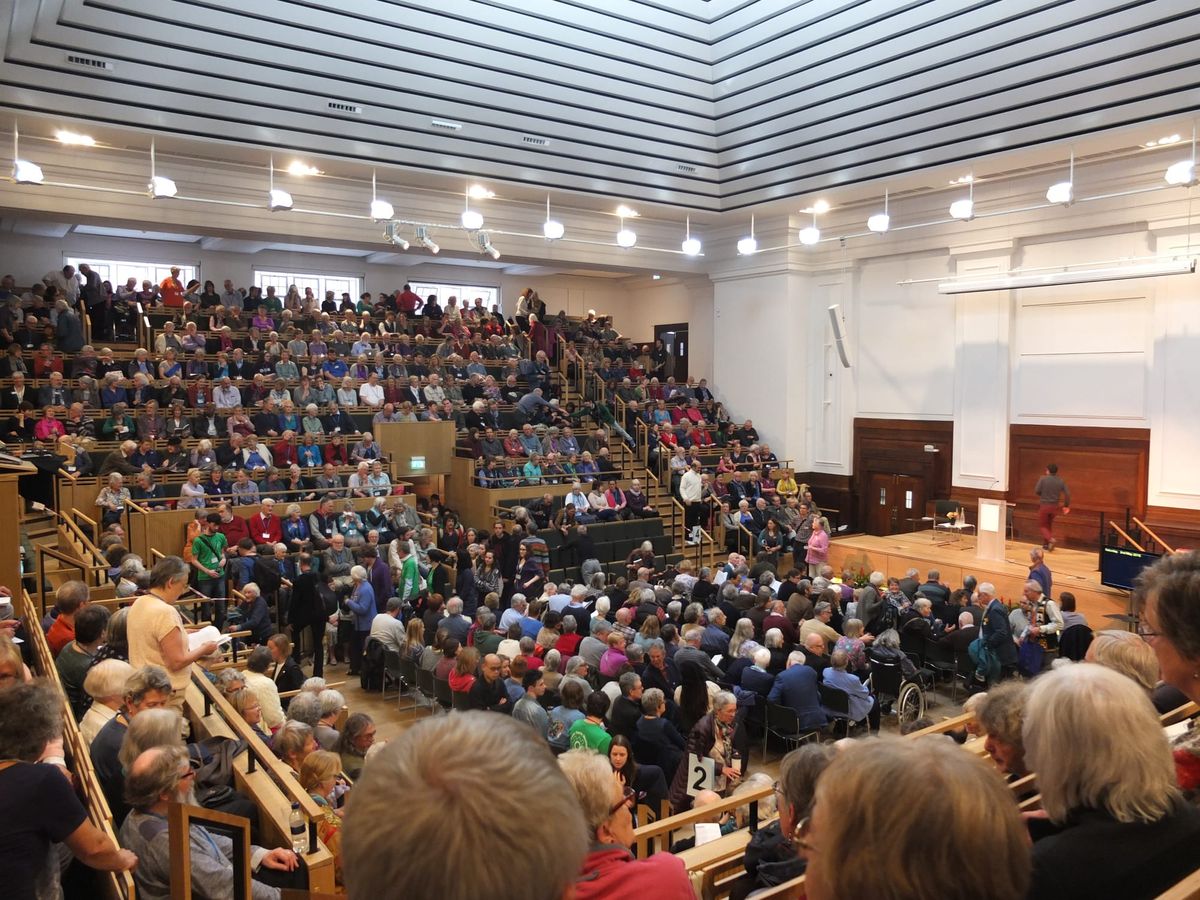
UCU and the Quakers are in some ways similar institutions. Both have thousands of members across the UK, both are arranged in an inverted pyramid of local branches supported by regional staff and a national organisation, and both have a few hundred sometimes under-appreciated employees who aren’t all themselves members, directed by national committees. UCU and Quakers each have to balance a practical role supporting local membership with a wider social justice, protest, and lobbying purpose—and each organise a multi-day blended yearly congress in May.
This was my first UCU Congress, and attending a few weeks after being at the Quakers’ Britain Yearly Meeting (BYM), I couldn't help comparing the two. Clearly there is no a priori reason why UCU must become more like the Quakers, nor is there any universally optimal way to run an AGM, and I am not particularly recommending any of BYM's practices be adopted by Congress: these are observations offered as food for thought only.
Some things were much the same. The chairs did an incredible job in sometimes difficult circumstances. The warmth shown to first-time attendees was touching, and I was impressed by the passion and bravery of all our comrades who got up to say something. Our paid staff and the hospitality team nailed their part in it all. The opportunity to meet people I’ve only known online and to spend more time with the delegates from my branch and region was great, and helped me feel more connected to the national work of UCU.
One of the most striking differences[1] was the length of the agenda. This year’s BYM agenda was nine pages. Congress’s agenda was a hundred-ish, and it grew larger still. To have a short agenda requires putting a ton of faith in the agenda committee to choose the right topics, and BYM’s agenda items come from the standing committees and area meetings[2], rather than directly from local meetings. Nine pages might not be possible for UCU, but it was sad to see the degree of slightly contagious anxiety comrades at Congress were feeling about whether there would be time to hear their motions, how much time was consequently spent debating rearranging the agenda, and how much of the agenda—motions our members worked hard on—then ended up being missed entirely. By contrast, the BYM agenda is sparse enough to have a free period that can be used for extra discernment on a piece of business that particularly needs it.
The advantage of BYM discussing a limited number of issues in depth is that the executive committees and paid staff get a strong mandate for what to do about the most important questions[3]. After spending hours discussing something, our priorities and positions eventually become clear. But the sheer volume of things hastily agreed to at Congress left me wondering if NEC now know what we thought was most urgent, and where they should focus UCU’s limited resources.
UCU has thousands of members, hundreds of branches, and faces dozens of threats, so “what are we going to do about the crisis in our sector?” is a complicated question that can only have a complicated answer. I don't see a way to break this down into an ordered set of yes/no choices. At BYM, Quakers don’t produce a series of binary outcomes, but collectively agreed written minutes (e.g. 2026’s), which aim to capture the diversity of thinking on each topic and allow for a creative response to develop during the session. An aspect of Congress I appreciated was when motions were taken in parts, allowing us to come to compromises, keeping the essential bits while editing out the parts we couldn’t agree on. Then, it felt like being present, debating together, was helping shape our strategy. Aside from these few moments, if we just speed through dozens of votes with minimal discussion, mostly arriving with our minds made up already, and no prospect of evolving our collective position during the debate, Congress seems little more than an expensive survey of a tiny subset of members. There may be reasons UCU can’t minute our debates in detail, but it might still be possible to incorporate a qualitative sense of the discussion into the Congress outputs somehow.
BYM ends with attendees working together with the meeting chairs and a dedicated committee to write an ‘epistle’ (e.g. 2026’s)—a short letter that is taken home and read out in meetings around the country. Most Quakers in Britain will eventually read or hear the epistle. The discipline of having to come together to distil four days of BYM into a two-page summary helps the attendees reach a shared understanding of what was most important in their discussions, and taking the epistle back to meetings helps to nurture the connection between Quakerism at the local and national levels.
After spending the best part of a week in a fairly nice hotel on UCU’s dime, I wish I knew better how to go back to OU members and give a sketch of what our union's strategy and priorities are for the next year, to save post-16 education, to build the union and win. We said ‘yes’ to a whole lot of things, ‘no’ to a few things, argued about the odd thing, but we still seem confused about the big picture: what ought we to do, where, when, and how?
The most striking difference of all is that Quakers don't vote or elect their committees. Of course this is not a way forward for UCU, but some of the valuable non-governance functions of Congress—celebrating branches that are winning, thanking staff and outgoing officers for their service, sharing organising tactics, remembering comrades who have passed away, helping members get to know their elected representatives, etc.—might be the sort of thing that could be given some dedicated space, and not forced into motions and motion speeches. In 1999 the BYM agenda committee wrote: "Our experience is that Yearly Meeting is most fruitful when its programme includes some decision-making and ‘doing together’, alongside more reflective sessions; and when it focuses on doing what only Yearly Meeting can do." ↩︎
An area meeting is something akin to a UCU regional committee, though there are more of them and they play a more significant role in Quakerism than the regional committees do in UCU. There are ~70 area meetings comprising ~400 local meetings. ↩︎
It may not be obvious what the 'most important questions’ are for Quakers. Suffice to say they are important to us, and can involve legal and reputational risks, allocation of resources, commitment to controversial political causes and lobbying, rule changes, and changes to the trustees' terms of reference: the two congresses are not entirely incomparable. ↩︎