
UCU Congress 2026 Report
By Lisa Rull
Several hundred delegates from branches across the four nations and from higher, further, prison and adult and community education, met in Harrogate last week for UCU’s annual Congress – the peak policy-making body of our union. UCU Commons members were also active over the last week, representing branches, regional committees and our equality standing committees. Below is a report from Dr. Lisa Rüll, member of the Women Members’ Standing Committee (University of Nottingham).
As with all Commons reports, the below reflects one member’s views, which aren’t necessarily shared by all Commons members – UCU Commons is a pluralistic group of left activists in the union, who organise in our union around a set of key values.
How do we address the challenges of the post-16 sectors?
All delegates could speak first hand of how post-16 education is facing significant challenges. Prison education needs to be nationalised. Further Education needs A New Deal, and the destruction of Adult and Community Education is a blight on enabling everyone to access post-16 education. As for Higher Education: it is on fire. The funding model is not working, but that’s just one element that needs addressing, as was noted in John Blake’s recent piece for the Post-18 Project entitled ‘Blood, debt, toil, and arrears: why thirty years of policy struggle has left us without the higher education system we deserve”. There was a lot of debate at HEC especially about the ‘need’ for national industrial action (NOW!), but we desperately need a strategy for what we require for all the post-16 sectors to function again.
We are still hybrid
After periods of discussion to move to hybrid for Congress, this was the second Congress to be fully hybrid, with online delegates able to move motions, contribute to debates and vote. It was unfortunate that during Day One there were considerable technical issues with the voting machines, though Civica staff were on hand to pass replacement machines to delegates. Our Higher Education Sector Conference (HESC) and Day three experienced far fewer problems and I remain convinced that overall the hybrid structure is an improvement. 70 delegates attended online (up from 50 last year). Is it perfect? No. Like any voting and participation system it will benefit from improvements.
Part of the logic of moving to hybrid, rather than wholly on-line or wholly in-person, is on the grounds of accessibility. What works for one person does not suit all regardless of perceived diagnosis or benefits of one format over the other. Bournemouth (our last Congress without hybrid participation) saw delegates unable to attend due to illness, but who could have attended online to avoid contagious interactions. This year, delegates could attend and participate, with only the everyday gremlins of connecting impeding them. Jo Edge was amongst those who were only able to attend at all due to hybrid being available, an option that had not been possible for Bijan Parsia in 2024.
Another aspect of accessibility that remains a problem despite being hybrid, is around the schedule and breaks. Disappointingly business ran over by nearly 20 minutes on Wednesday with an important Composite Motion on the National Fighting Fund that created a heated debate. Going beyond the 6pm close of business without having voted to extend meant UCU staff worked beyond their expected hours and the Congress Childcare closed at 6pm. If we seriously want to support delegates with children using this important provision, we cannot drift beyond close of business (Congress runs around the late May half-term week to accommodate FE colleagues who have much less flexibility to attend). Thankfully, Dyfrig Jones as Vice-President and Chair of the Higher Education Sector Conference (HESC), Thursday closed promptly. The FESC finished early after Chair and Vice President Suzi Toole asked for a vote to complete business rather than taking a 20-minute break. Business was then finished within 10 minutes and they rightly headed outside. This shows good practice on handling breaks which unfortunately was less well done on Friday. President Maria Chondrogianni called to continue with business rather than take the scheduled break. Delegates had to ask to put this to a vote and we got the break. Breaks are essential, whether you’re online or in-person, and it was frustrating that this was proposed, making a number of delegates feel they had to beg to get such a core accessibility provision.
It was suggested we continue with business because… quelle surprise, lots of motions were falling from the agenda. This brings me to…
Delegates vote to elect our Congress Business Committee
Our annual Congress is formed of three days of business: we open with speeches from the current President Maria Chondrogianni and our General Secretary Jo Grady, and then should move on to the agenda. Day two focuses on the issues specific to our two key sectors: higher education (which accounts for about 2/3 of members and delegates) and further education (which covers the balance). These conferences allow sector-specific issues to be discussed by those affected, which includes things like policies for industrial strategy (though implementation of Industrial Strategy is the business of the National Education Committee [NEC] and elected officers). Day three returns to the cross-sectoral business. Congress sets policy based on motions submitted by local branches, regional committees, and national committees. With 78 motions on cross-sectoral issues, and 29 for the Higher Education Sector Conference (28 for Further Education Sector Conference), there was a lot of business to cover.
Congress Business Committee formulates the agenda and works to composite similar motions received from multiple branches. In doing so, it follows the priorities set by NEC which includes those elected to our Higher Education Committee [HEC] and the Further Education Committee [FEC]). The amount of time spent during Congress with challenges to CBC in how they had followed UCU rules and the NEC agenda order was frustrating. A significant number of excluded motions or parts of motions were ultimately ruled back on the agenda, with knock-on effects to several key areas of business. CBC members are elected by Congress - we entrust them to do this, and they do this work diligently, including meeting repeatedly throughout Congress. But then delegates vote to ignore them. The challenges to CBC exacerbated the technical challenges that were especially an issue on Day one, and that meant that the first actual motion of the Congress agenda was moved at 12:15pm (having opened at 9:30am). We lost more time at both HESC and on the final day of business debating the agenda.
We need better ways of both agreeing and keeping to an agenda so that the tens of thousands of our members beyond the Congress location can feel they have a voice in our Union.
Active International Solidarity
Whilst there was a large delegate photo taken to show support to Palestine (we remain unwavering as a union in our support of the Palestinian people), there remains a tendency to focus on expressing solidarity which can feel rather ‘thoughts and prayers’ rather than enacting practical actions and support. It was good to see a Late Motion on the Emergency in Lebanon that proposed a donation to UNRWA and the Lebanese Red Cross. With the war in Iran affecting multiple gulf nations in West Asia, we should work to find ways to support students from the area and our colleagues in education across the region (and beyond). There are many conflict zones across the world including Ukraine and Sudan, and many more, on which there was no mention. I think we can agree that War is Bad, and that writing to world leaders to demand action, or taking a motion to TUC is unlikely to shift the dial. We need to be pressing our employers to look at scholarships and shared resources and fellowships. Practical actions are vital.
Trans rights are human rights
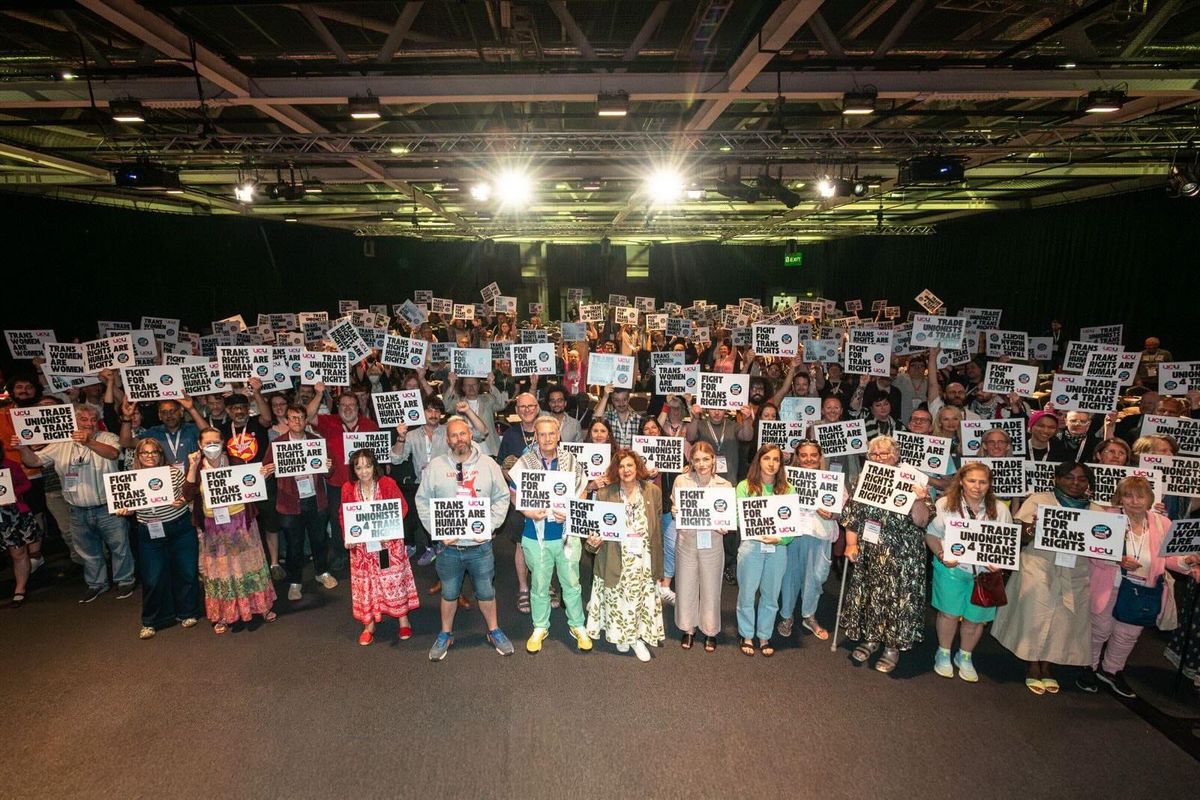
Our other delegate photo at Congress was in support of our core value (in both Commons and UCU as a whole) that Trans Rights are Human Rights. Commons members were pleased to drive an amendment to a motion on supporting Migrant Members in order to remove an insidious call to affiliate with FiLiA (an openly transphobic organisation) and Project Resist (who make no indication of being inclusive). Jo Edge moved this amendment which was submitted by both the Women Members Standing Committee and the LGBTQ+ Members Standing Committee (including Matilda Fitzmaurice, Chair of Equalities Committees). We do not wish to purchase rights against the rights of others.
Making our contributions
Across the three Congress days, the majority of our Commons attending delegates spoke at least once (including me!). I especially want to thank those who serve on NEC who stood up to speak on so many issues, including those that were proving contentious to those attending. We must find better ways to respectfully disagree on substantive matters. Several reminders on the levels of noise, heckling and other disruptions were required across the days.
Recruitment, Organising and Campaigning
Despite many motions scheduled to be voted on at Congress in this area, just ONE motion was voted on to enable the ROC Committee priorities for the coming year. Last year, most of the Equalities motions fell from the agenda. We have to do better. These should be core to our functioning as a Union.
Budgets and Finances
Whilst personally sympathetic to the intention of the motion on access to the Fighting Fund, if we are a cross-sectoral union, this is not straightforward. Many (though not all) HE institutions have local hardship funds and capacity to fundraise. Smaller institutions and everything within FE have little to nothing. The implications of voting to increase the Fighting Fund without consideration of what this will be at the expense of was concerning. Much as everything feels urgent and needs addressing now, we cannot do everything simultaneously.
Thank you and next steps
Congress marks the annual turning point in the composition of our National Executive, National Officers and all subsidiarity committees. This year we are saying goodbye to our most excellent Commons NEC member Jo Edge who has served six years representing Women Members and is a driving force for good in supporting Commons members to elected positions. In the meantime, she and Commons members Matilda Fitzmaurice and Ben Pope are pushing the work of the Anti-Casualisation Committee, including the current survey.
We have two new members of UCU Commons joining NEC for 2026-27 – Gillian Jack (Open University, UK-elected), and Alex Prichard (University of Exeter, representative of UK wide members). We are also pleased to have Matthew Barnard (Manchester Metropolitan University, North-West Region) returned to NEC following his earlier election to a Casual Vacancy UK-elected post on NEC. As always, our elected members are contactable via the NEC contact form on the UCU website – please do reach out if you have any questions or would like to let us know the views of your branches and fellow members.
Elections to various other national roles – including UK-wide negotiators on pay and pensions, Congress Business Committee and the Conduct of Members Committee – have also taken place recently. While we are yet to receive the outcomes of those votes, several Commons members put themselves forward and all look forward to serving members if elected. We’ll update this list further once the outcomes of those elections are announced.
We look forward to our Vice-President Mark Pendleton taking us through HESC next year and all the work he is already planning to undertake in collaboration with UCU staff.